[LinkedIn Newsletter] The 2026 Leadership Paradox: Is Your 'People-First' Culture Actually a Burnout Trap?

Here's the stat that should make every leader pause: 72% of HR leaders report that employees now have significantly heightened expectations for support and authenticity from their organizations.
Sounds like progress, right? Employees finally demanding what they deserve, genuine support, real connection, leaders who actually care.
But here's where it gets messy.
While three-quarters of HR departments are scrambling to meet these expectations, there's a dangerous gap forming. Organizations are rushing to slap "people-first" labels on their culture while simultaneously rewarding the exact behaviors that lead to burnout. Welcome to what experts are now calling "Culture Dissonance", and it's burning through teams faster than you can say "wellness initiative."
The Performance Trap Nobody's Talking About
Let me paint you a picture of what Culture Dissonance looks like in real time:
Your company launches a mental health initiative. Beautiful Slack announcement. Earnest email from the CEO about "prioritizing well-being." Maybe even a meditation app subscription for everyone.
Meanwhile, your top performer just worked their fourth consecutive 60-hour week because the project deadline didn't move, the budget didn't increase, and "doing more with less" is still the unofficial motto printed on invisible business cards.
The message your team actually receives? "We care about your wellness... but we care about those KPIs more."
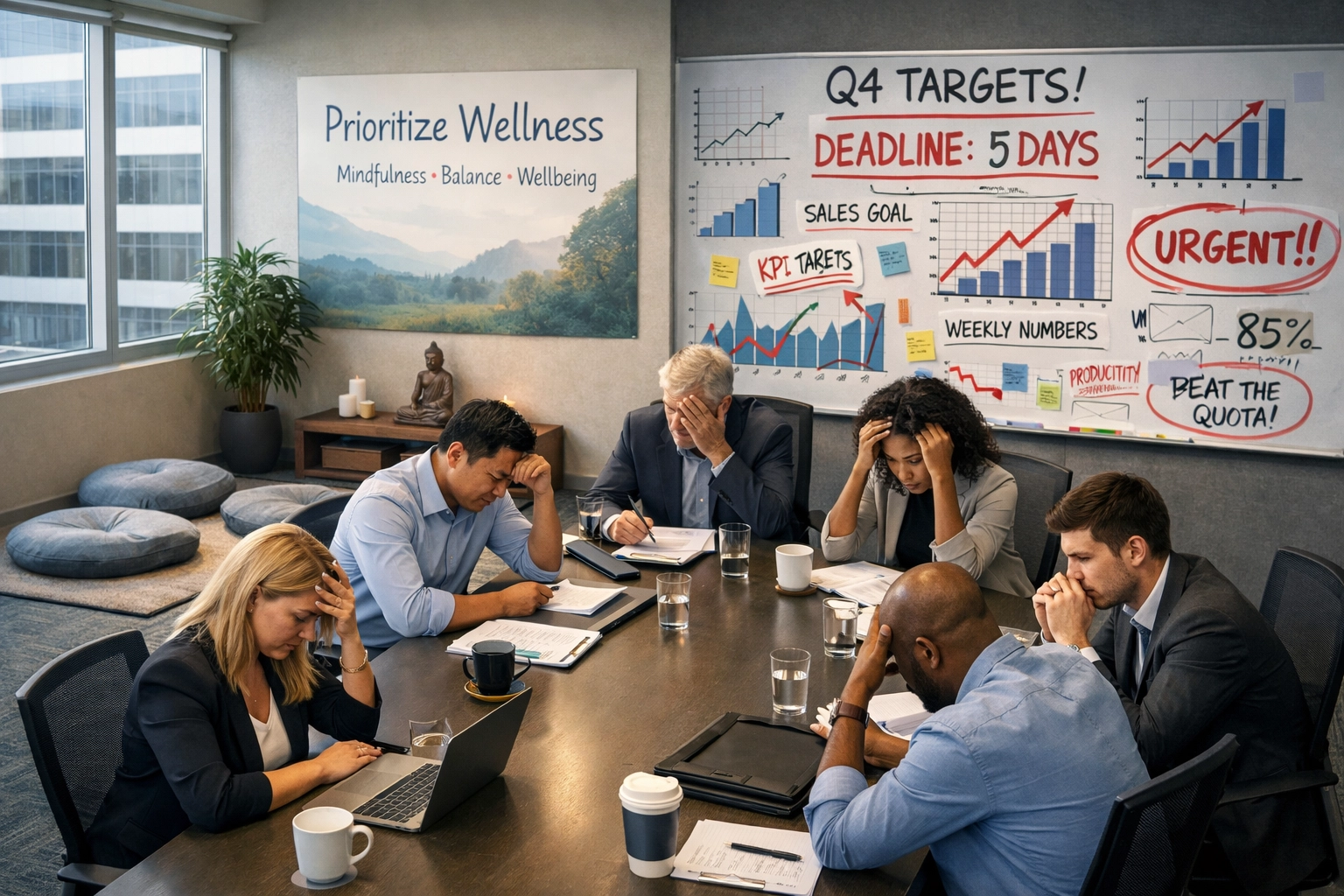
This isn't theoretical. Organizations are celebrating "people-first leadership" as revolutionary when treating employees like actual humans should be foundational. The fact that we're applauding leaders for "remembering that employees aren't productivity algorithms with human avatars" tells you everything about how far we've drifted.
The 2026 Reality Check
Here's what's actually happening in organizations right now:
📊 The Surface Metrics Look Great:
Engagement surveys show improvement
Feedback sessions are scheduled
Diversity hiring numbers are up
Leadership training focuses on empathy
🔥 But Beneath the Surface:
Your star developer says "everything's fine" while secretly interviewing elsewhere
Managers show +2.80% improvement in handling criticism but -2.69% decline in resolving team conflicts
Employees give "green light responses" that mask deeper problems
Trust erosion builds for months before anyone notices
The paradox? Leaders are becoming more self-aware while simultaneously losing the ability to execute on team dynamics. They can talk about psychological safety but can't create the conditions for it to actually exist.
Why People-First Became Performative
Post-COVID, many leaders briefly embraced flexibility, empathy, and authentic connection. But as the "emergency phase" ended, the drift back to KPI-first communication accelerated. The erosion happened in the silence, in the meetings where results were prioritized over people, in the decisions where short-term gains trumped long-term culture, in the moments where saying "yes to everything" became the path to advancement.
Now we're left with organizations implementing people-first strategies without genuine structural change. It's the corporate equivalent of putting a Band-Aid on a broken bone and wondering why it's not healing.

The real burnout risk isn't people-first leadership itself, it's using it as a diagnostic-free solution. When you adopt empathy initiatives without understanding why your culture deteriorated in the first place, you're applying treatment without identifying the disease.
Enter: Return on Relationship (ROR)
This is where Return on Relationship becomes your lifeline instead of just another leadership buzzword.
ROR isn't about adding more to your plate. It's about fundamentally shifting how you show up, what you reward, and where you invest your leadership capital. It's the antidote to Culture Dissonance because it forces you to align your stated values with your actual behaviors.
Here's what ROR looks like in practice when you're navigating the 2026 leadership paradox:
Instead of: Announcing a mental health day while keeping all project deadlines intact ROR Approach: Adjust timelines when you announce wellness initiatives. Show that priorities can actually shift.
Instead of: Praising "work-life balance" while promoting the person who never unplugs ROR Approach: Make boundaries part of your performance criteria. Recognize sustainable excellence, not burnout-fueled sprints.
Instead of: Running engagement surveys and filing the results ROR Approach: Build early detection systems for trust erosion. Act on feedback before your top talent starts job searching.
Instead of: Adding empathy training to your leadership development ROR Approach: Develop conflict resolution skills alongside self-awareness. Being nice isn't enough if you can't navigate hard conversations.
The Organizations That Will Actually Survive This
The companies avoiding burnout crises in 2026 aren't the ones announcing people-first resets with splashy campaigns. They're the organizations that never stopped maintaining their culture in the first place.
They built systems to detect trust erosion before engagement scores collapsed. They aligned rewards with stated values from day one. They didn't wait for employees to demand authenticity, they embedded it into how decisions get made, how performance gets evaluated, and how leaders get promoted.
They understood that Culture Dissonance doesn't happen overnight. It happens in a thousand small moments where actions don't match words.

Your Monday Morning Action Plan
If you're reading this and thinking "oh crap, we might have a Culture Dissonance problem," here's where to start:
1. Audit Your Rewards System What behaviors are you actually rewarding? Not what you say you value, what gets recognized, promoted, and praised? If it's "always-on availability" and "never saying no," you've found your dissonance.
2. Close the Gap Between Words and Action Pick ONE stated value. Just one. Now track every decision your leadership team makes this week against that value. Where do the mismatches show up?
3. Build Your Early Warning System Don't wait for annual engagement surveys. Create regular check-ins that actually surface problems. And here's the key: make it psychologically safe to tell the truth.
4. Invest in ROR Not as a program. As a framework for every decision. When the deadline pressure hits, when the budget gets tight, when the "do more with less" whisper starts: that's when ROR becomes your north star.
The Bottom Line
The 2026 leadership paradox isn't unsolvable. But solving it requires more than adding empathy workshops to your L&D calendar. It requires building cultures where authenticity isn't performative, where boundaries don't torpedo your career, and where heightened expectations for support are met with actual structural change: not just better PR.
Your employees aren't asking for the impossible. They're asking you to close the gap between what you say and what you do. Between the culture you advertise and the culture you actually create.
That's Return on Relationship in action. And it's the only sustainable path forward.
Ready to close your Culture Dissonance gap? Explore ROR resources, coaching cards, and frameworks designed to help you build authentic leadership that actually sticks: https://www.roxannederhodge.com/product-page/ror-digital-copy-and-coaching-cards
Drop a comment: Where have you seen Culture Dissonance show up in your organization? Let's talk about it. 👇
Comments